The most vibrant floating market of Siam — wooden paddle boats laden with fruit and local food ply a historic canal first dug in the reign of King Rama IV
Thailand's most iconic and historic floating market, set along the Damnoen Saduak Canal in Ratchaburi Province
The Damnoen Saduak Canal was commissioned in the reign of King Rama IV to shorten the waterway between Bangkok and southern Thailand. Stretching over 32 km, it became a historic trade route, and the floating market grew along its banks over the following decades as villagers paddled out to trade their orchard produce.
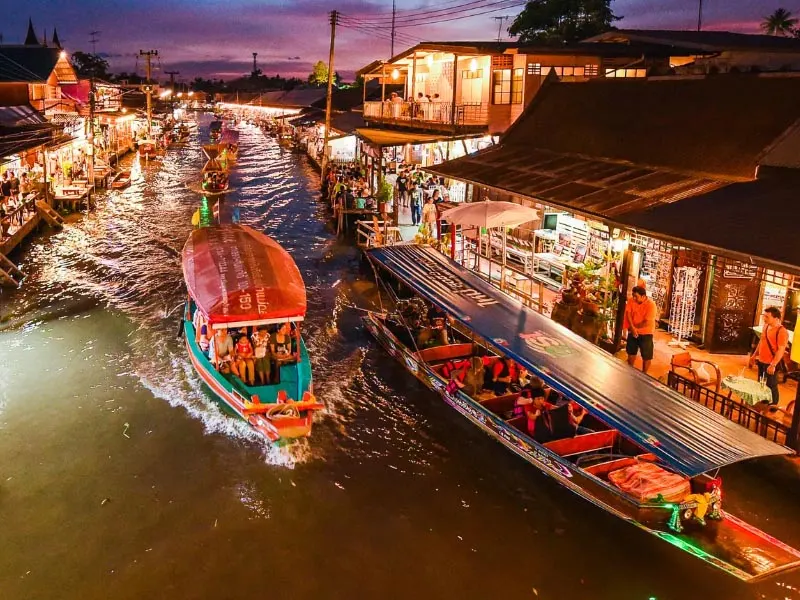
Every early morning, brightly painted paddle boats line up selling pomelo, bananas, young coconut and home-cooked food, letting visitors experience the authentic riverside life of old Siam that still survives today.
“A floating market is not just a place to trade — it is a way of life that floats upon the water”
32 km
Length of Damnoen Saduak Canal
160+ yrs
Age of this riverside market
07:00–17:00
Market grounds open (liveliest before 11:00)
01
Paddle boats
Wooden canoes and long-tail boats brimming with colourful goods
02
Riverside food
Boat noodles, Thai sweets and fresh garden fruit
03
Culture
A riverside community life passed down for generations
Editor's tip
Arrive at dawn (07:00–09:00) for the softest light and the liveliest atmosphere
Weather, canal water levels and orchard harvests all shape what a visit feels like. This table summarises what to expect in each part of the year.
Season
Months
Weather
Canal & orchards
Crowds
Advice
Best
Cool season (high season)
Nov – Feb
Roughly 20–32°C, little rain and many clear mornings with a cool breeze.
Canal water drops and clears; orchards deliver their main harvest of pomelo, rose apple and coconut.
The busiest stretch of the year, especially long weekends and the New Year period.
Arrive before 07:00 to secure a boat and the best light, and book accommodation 2–4 weeks ahead.
Fair
Hot season
Mar – May
25–36°C with strong midday sun; rain returns late in the season and Songkran falls in April.
Canal levels run low and orchard trees begin to flower, so fresh fruit is less abundant.
Fewer visitors overall, except during Songkran when the area is exceptionally busy.
Start boating at 07:00, carry a hat and water, and avoid standing in direct sun between 12:00 and 14:00.
Good
Early rainy season
Jun – Aug
Short showers, usually in the afternoon or evening, with sun and cloud alternating by day.
Water levels rise and the orchards turn lush; coconut and tropical fruit are plentiful.
Fairly quiet — a good window if you want canal photographs without crowds.
Pack a folding umbrella or rain jacket and move your boat trip to the morning to dodge afternoon rain.
Plan ahead
Late rainy season
Sep – Oct
The wettest part of the year, with rain that can persist for several days and heavy cloud.
Canal levels peak and some orchard land is temporarily flooded.
Quietest period of the year, offering the most everyday atmosphere.
Check the daily forecast before travelling and allow extra time for the journey.
Water levels and fruit harvests vary with each year's rainfall, so conditions may differ from these typical patterns.
— 11 · Weather & Seasons —
Today's weather and the days ahead
Temperature, humidity and rain chance for the market's exact location, so you know whether to pack an umbrella, a hat or a rain jacket before you set off.
Right now
31°
Partly cloudy
Feels like
35°
Humidity
60%
Wind
8 km/h
· Force 2
Chance of rain
80%
Rainfall
0.8 mm
High/Low
34° / 24°
☀ Sunrise 06:19☾ Sunset 17:49
⚠Weather warning
⚠Take care
What it means for your visit
Best window on the water today
16:00 – 18:00 Early hours are the coolest; shade gets scarce once the afternoon heat builds.
👕What to wear
•Rain is expected — wear a rain jacket or quick-drying fabrics and shoes that tolerate water.
•Hot and humid — wear light cotton, bring a wide-brimmed hat and sip water throughout the boat ride.
🗺How to plan the day
•Intermittent rain — go out early and keep a covered, riverside fallback plan for later.
•Strong sun and heat — take the boat trip early and rest in the shade during the afternoon.
🎒What to bring
Umbrella or rain jacket
Drinking water
Small cash for riverside purchases
Next 7 days
Today
Light drizzle
34°
/ 24°
💧 80%
Tue 17 Nov
Thunderstorm
32°
/ 24°
💧 81%
Wed 18 Nov
Drizzle
32°
/ 23°
💧 67%
Thu 19 Nov
Light showers
32°
/ 24°
💧 86%
Fri 20 Nov
Light drizzle
33°
/ 23°
💧 69%
Sat 21 Nov
Light drizzle
32°
/ 24°
💧 53%
Sun 22 Nov
Light drizzle
32°
/ 23°
💧 24%
— 03 · History & Legend —
The History & Legend of the Waterway
The story of Damnoen Saduak begins with the historic canal that linked the western towns of Siam together
01
The Damnoen Saduak Canal (Rama IV)
During the reign of King Mongkut (Rama IV), a canal was commissioned to shortcut between the Mae Klong and Tha Chin rivers, cutting the waterway from 14 leagues down to just 32 km. Villagers soon adopted the canal as their main trading route.
02
The golden age of the floating market
After the canal opened, the riverside community flourished. Paddle boats plied their trade energetically, and Damnoen Saduak became the commercial and transport hub of Ratchaburi and the surrounding provinces.
03
From a way of life to local heritage
Even as land transport took over, the market preserved its riverside way of life. Today it stands as one of Thailand's most important tourism symbols and is registered as a local intangible heritage.
The legend of the paddle boats
Locals tell that the paddle boats which set out at dawn pass good fortune from one generation to the next — whoever tastes the first pomelo sold from a boat at the start of the day will meet prosperity all year long.
Did you know?
The Damnoen Saduak Canal took two full years (1866–1868) to dig, using only manual labour with no modern machinery
— 15 · Stories & Local Lore —
Tales from the Damnoen Saduak waterway
Beyond the documented history, stories have been passed down by the people who live along the canal. Each entry below is labelled so you can tell recorded history apart from local legend.
01
Recorded history
A canal dug by hand in two years
The Damnoen Saduak canal was excavated between 1866 and 1868 during the reign of King Mongkut (Rama IV). It took roughly two years using human labour and simple tools rather than heavy machinery, which is why it ranks among the largest irrigation works undertaken in Siam at the time.
02
Recorded history
A name that means 'travelling with ease'
The name Damnoen Saduak expresses the purpose of the canal directly: to make movement between the two river systems shorter and easier. Before it existed, journeys had to detour around the river mouths and could take several days. The canal cut the route down to roughly 32 kilometres.
03
Recorded history
The canal that created an orchard province
Once the canal opened, smaller channels were dug off it to carry water into farmland. Growers planted coconut, pomelo, rose apple and banana in earnest, and Ratchaburi became one of central Thailand's key fruit regions. The floating market itself grew out of the produce of those orchards.
04
Recorded history
From village market to a national image
This canal-side market began as a trading point for local residents. As Thai tourism expanded during the twentieth century, the sight of a paddle boat and a palm-leaf hat became one of the most widely recognised images of the country — and the community adapted to serve visitors from around the world.
05
Local legend
The first pomelo of the day
Locals along the canal say that pomelo sold from the first boat of the day brings good fortune to both seller and buyer. Whoever tastes fruit from a boat that sells out before any other is said to enjoy luck for the rest of the year — which is why some visitors arrive early to be the first customer.
06
Local legend
The last boat at sunset
Another story holds that the final paddle boat returning to the pier closes the canal for the day. Anyone standing on the bank who watches it drift past without calling it over, the story goes, will travel safely for the whole of that journey.
07
Custom & daily life
Bargaining, politely
Haggling over boat fares and souvenirs is a normal local practice. The usual approach is to open slightly below the asking price and settle gradually with a polite manner and a smile. Agreeing the fare before boarding keeps expectations clear on both sides.
08
Custom & daily life
The palm hat and checkered cloth
The woven palm-leaf hat and the brightly checkered pha khao ma are the working uniform of riverside traders. The hat blocks the sun beautifully, while the cloth serves as a towel, a sun shield and a boat cushion. This is not costume for visitors but practical design refined over centuries of use.
— 04 · Visitor Guide —
Damnoen Saduak Visitor Guide
Everything you need to know before you set off, so your visit is smooth and worthwhile
⚠️ Avoid scams (official pier guide)
Watch for unclear boat quotes at roadside piers. Check your chosen boarding point within the market area, compare operators, and confirm the total fare, whether it is per person or per boat, the duration and the route before paying.
01
Opening hours
Daily from around 07:00
Liveliest trading (boats & stalls)07:00 – 11:00
Boat rentals08:00 – 16:00
Land-side stalls & shopsuntil ~17:00
02
Estimated costs
Market entry
Free — no gate fee
Long-tail boat tour
Approx. 300–600 THB / boat (per round)
Paddle / kayak rental
Approx. 150–300 THB / hour
Food & fruit
From 20–50 THB
03
Getting there
Private car
From Bangkok take Highway 9 then 340, ~100 km, about 1.5 hrs
Van / songthaew
Van from Bangkok Southern Bus Terminal to Ratchaburi, then a songthaew to the market
From the airport
The nearest airports are Bangkok's two hubs (Suvarnabhumi / Don Mueang); on arrival, drive, take a van, or join a transfer-included day tour — about 1.5–2 hrs by road
Day tour
Bangkok day-trip packages including transfer and a canal boat tour
02B
Boat types & standard prices
Reference fares so you can compare at the pier and avoid overpaying
Hand-rowed paddle boat (เรือพาย)
Capacity2–4 passengers / boat
Price150–300 THB per boat per hour
Best forPhotography, slow canal experience, small groups
Tip: Confirm the hourly rate and route length before boarding
Long-tail motor boat (เรือหางยาว)
Capacity6–10 passengers / boat
Price300–600 THB per round-trip (about 45–60 min)
Best forLarger families, short on time, reaching outer canal sections
Tip: Ask whether the price includes stops at food / fruit boats
Kayak / self-paddle
Capacity1–2 persons
Price150–250 THB per hour
Best forIndependent travellers, avoiding crowds
Tip: Wear a life jacket and keep to the canal edges
Shared boat (join-in)
CapacitySeats filled with other travellers
Price60–150 THB per person per round
Best forSolo travellers, budget option
Tip: Depart when the boat is full; wait times vary
Frequently asked questions
Which day is best to visit? +
Weekdays are quieter than weekends, and pre-dawn gives the most authentic atmosphere.
Do I need to book a boat in advance? +
Mostly you can rent at the pier on the spot, but during festivals booking via your hotel or a tour is recommended.
Is vegetarian or vegan food available? +
Yes — many Thai-dessert and fruit boats, and some boats offer vegetarian options.
Can I get there by public transport? +
Yes — van from Bangkok to Ratchaburi then a songthaew, or join a day tour.
Should I bring cash? +
Yes. Bring small notes, because many boats and stalls take cash only. Some vendors display QR payment codes, but the mobile signal can be unreliable.
How long does it take to get there from Bangkok? +
Roughly 1.5 to 2 hours from central Bangkok depending on traffic. If you want to arrive before 07:00, leave before 06:00.
Are there toilets and parking? +
Both are available around the main market entrance. Parking is charged per vehicle and toilets usually cost a small fee, so bring tissues.
What should I do if it rains? +
Browse the covered land-side market, or wait for the shower to pass before taking a boat. In the rainy season, always carry a folding umbrella or rain jacket.
Can I visit with small children or older relatives? +
Yes. Fit children with life jackets whenever they are on a boat, avoid the midday heat, and use the land-side walkways for older visitors as the surface is smoother.
What should I wear? +
Light, breathable clothing such as cotton or linen, a wide-brimmed hat, sunscreen and shoes with good grip — the timber walkways get slippery after rain.
Is the market open every day, and when is it quietest? +
It operates daily, roughly 07:00 to 17:00. The quietest times are weekday mornings after 10:00 and the late rainy season from September to October.
What boats should I choose? Paddle, long-tail or kayak? +
For a quiet, photogenic experience pick a hand-rowed paddle boat (150–300 THB/hour). For a larger group or limited time choose a long-tail boat (300–600 THB/round). Independent travellers on budget can try a self-paddle kayak (150–250 THB/hour). Always confirm the rate and route before boarding.
Plan your visit: deep-dive guides
Practical answers on hours, boats, transport, scams and a Maeklong combo trip.
Beyond the main canal there are orchard tracks and riverside communities you can walk. Pick a route that matches the time you have and who is travelling with you.
Standard itineraries (half day / full day)
Morning half day
About 4 hours
Best for: Travellers passing through or with limited time in Ratchaburi.
Focus: The atmosphere of the main canal and riverside food
Step by step
0106:30 Leave Bangkok or your Ratchaburi hotel to arrive ahead of the first tour groups.
0207:00 Reach the main pier, agree the price and route before boarding.
0307:15–08:30 Cruise the market at its liveliest, with trading on boats along both banks.
0408:30–09:30 Step ashore at the main market for boat noodles and Thai snacks.
0509:30–10:00 Browse the riverside shops and buy pomelo or local fruit to take home.
If your time is very tight, concentrate on 07:00–08:30, when the market is at its busiest.
Full day
About 7–8 hours
Best for: Visitors who want the market, the orchards and riverside village life together.
Focus: Floating market + orchards + canal-side daily life
Step by step
0106:30–09:30 Cruise the floating market and explore the main market on the half-day morning route.
0209:30–11:00 Continue by boat or car to surrounding orchards such as coconut or pomelo farms.
0311:00–12:30 Have lunch at a riverside restaurant in one of the nearby communities.
0412:30–14:30 Cycle or walk the canal lanes past orchards and wooden houses.
0514:30–16:00 Visit a waterside temple or local architecture and prepare to head back.
0616:30 Return to Bangkok before the evening traffic builds.
Arrange a car and driver for the day — there is no regular public transport between the outlying orchards.
Classic combined day trip
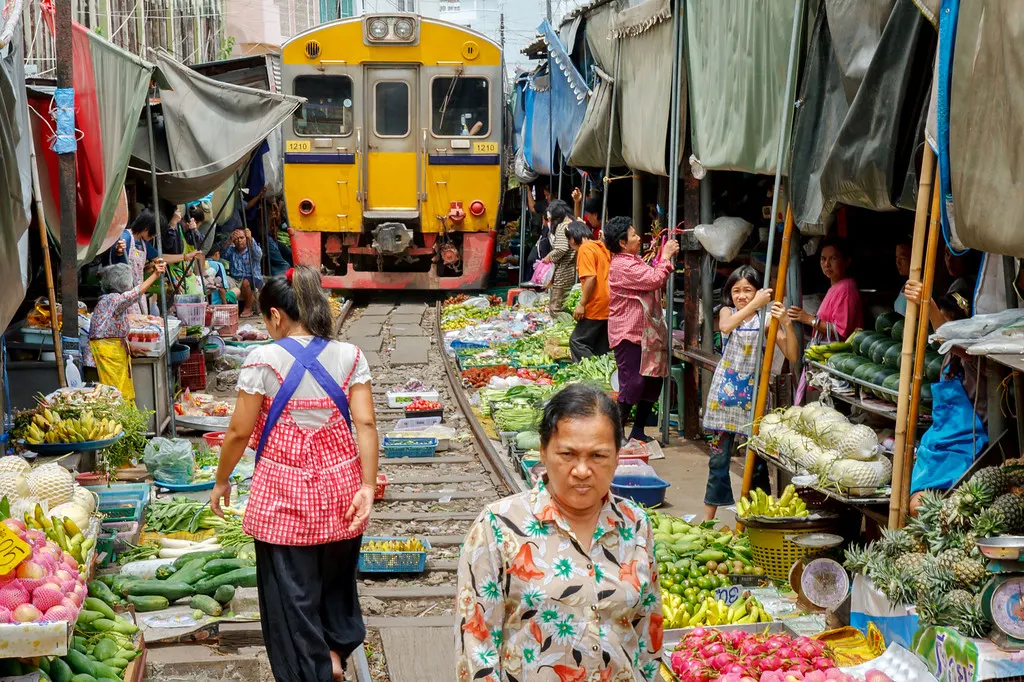
Maeklong Railway Market sits only ~20 minutes by road from Damnoen Saduak. For most first-time visitors, combining both is the single most popular and efficient day trip from Bangkok.
Damnoen Saduak + Maeklong combined
8–9 hours (full day)
Best for: First-time Thailand travellers who want both iconic day-trip highlights in one ride.
Focus: Floating canals in early morning + railway umbrella market in the afternoon
Step by step
0106:00 Leave Bangkok to beat the southern highway traffic.
0207:30 Reach Damnoen Saduak main pier; confirm your boat rate and cruise the busy market canals.
0309:30 Step ashore for breakfast and pick up pomelo, coconut or souvenirs.
0410:30 Drive to Maeklong Railway Market (~20 minutes if the route is clear).
0511:00–12:30 Walk the Maeklong market lanes and time your visit for one of the scheduled train passes.
0612:30–13:30 Lunch at a riverside or Maeklong local restaurant.
0714:00 Optional: Ampawa floating market (if open / Friday–Sunday weekends) or head back to Bangkok.
0816:30 Arrive back in Bangkok before the full evening rush.
Use a single private driver for the day so you are not stuck waiting for vans between the two markets.
Itineraries by traveller type
Three routes tuned to the pace and needs of different groups.
👨👩👧
01
Families with young children
Duration:
About 3 hours
Focus:
Safety, an unhurried pace and frequent rest stops
·Start at the main pier and fit children's life jackets before anyone boards.
·Take a short 30–45 minute canal loop during the morning while the sun is still gentle.
·Go ashore to a shaded riverside area for snacks and a toilet stop.
·Wander the souvenir and Thai-snack stalls with no fixed schedule.
·Finish with ice cream or a cold drink before heading back.
Avoid 12:00–14:00 when the sun is strongest, and carry water and hats for the children.
📷
02
Photographers & nature lovers
Duration:
About 4–5 hours
Focus:
Morning light, the work of the vendors and the orchards
·Arrive before sunrise to catch soft light and light mist over the water.
·Shoot from the bank before boarding — the riverside angle frames the market better.
·Take a boat into the narrower side canals for wooden houses and everyday life.
·Return to the land market between 09:00 and 10:00 for close-range trading scenes.
·Finish at the outlying orchards for natural detail and irrigation channels.
Ask before taking close-up portraits of vendors, and never block the boat traffic lanes.
♿
03
Older visitors & wheelchair users
Duration:
About 2–3 hours
Focus:
Short, level routes with frequent seating and nearby facilities
·Begin on the land-side market, where the walkways are smoother than the piers.
·Choose a short 20–30 minute boat ride along a wide, quieter stretch of canal.
·Rest at a riverside shop near the main entrance, where there is shade and seating.
·Browse only the front row of stalls, where the aisle is widest and seating appears regularly.
·Return to the car park by the same route to avoid steps and wooden bridges.
Riverside walkways are timber and become slippery in rain; bring a companion and wear shoes with good grip.
— 14 · Visitor Services & Facilities —
Visitor services around the market
An overview of the types of services found around the floating market and the surrounding community, provided purely to help you plan.
🚻
Public toilets
Toilets are located near the main market entrance and the boat piers. There is usually a small charge and some facilities do not supply paper.
Bring tissues 🅿️
Parking
Several private car parks sit around the market entrances and charge per vehicle. Note the name or position of your car park so you can find it again.
Fills early on holidays 🍜
Restaurants & snacks
Beyond food sold from boats, there are riverside restaurants and drink stalls, both indoors and open-air along the canal.
Vegetarian options exist 🏨
Accommodation
Places to stay range from small hotels and resorts in Damnoen Saduak district to homestays along the canal and lodging in nearby districts.
Book ahead in high season 🛒
Convenience stores & supermarkets
Convenience stores and local shops line the main roads before the market — useful for water and essentials at normal prices.
Cheaper than in-market ⛽
Fuel stations & EV charging
Service stations are found along Highway 325 and the main approach roads, and some now offer electric vehicle charging points.
Refuel before the market 💊
Pharmacies & medical care
Pharmacies operate in the district centre and a community hospital is within a short drive of the market.
Carry your own medication 🏧
ATMs & payment
ATMs are available along the main roads, but many market stalls still take cash only and mobile payment signals can be unreliable.
Carry small notes ♿
Wheelchair access
Land-side market walkways are smoother than the pier area, but some boat ramps and wooden bridges have steps. Ask locally about the most suitable route before entering.
Bring a companion 🧳
Left luggage & tourist services
Some market areas have left-luggage points and tourist service counters, which help if you are travelling onward after your visit.
Check closing times
This list describes categories of service only. No business is endorsed or advertised. Always check prices, opening hours and conditions yourself before using a service.
— 05 · Flavours of the Waterway —
Flavours of the Waterway
Floating kitchens that serve you right at your boat — a charm you won't find anywhere else
01
Boat noodlesfrom 40 THB
Pork boat noodles with coconut milk and tamarind, rich and deep
02
Kanom krokfrom 20 THB
Coconut-rice pancakes, crisp edges, soft centre, fragrant with coconut
03
Damnoen Saduak pomelofrom 50 THB
Local pomelo, juicy and sweet with a balanced flavour
04
Boat coffeefrom 30 THB
Old-style coffee brewed from a paddle boat, served ice-cold
“The true taste of Damnoen Saduak is a flavour served from boat to boat”
— 16 · Understanding & Responsibility —
Travel with understanding and help protect the waterway
The Damnoen Saduak canal is not only a tourism backdrop — it is an ecosystem and the home of thousands of households. A few basic practices make a visit better for everyone.
The canal ecosystem
01
The water
The canal links the Mae Klong and Tha Chin river systems, so water quality and level shift with the rainy season, drainage from surrounding farmland and conditions in the main rivers. In the rainy season the water runs higher and murkier, while late in the cool season it is often clearer and slower.
02
Wildlife in and around the water
The canal and its side channels support many freshwater fish as well as frogs, snails and crabs. Water birds such as herons and kingfishers are common along the banks, and the area's most frequently seen large reptile is the water monitor, which often forages close to the water's edge.
03
Plants and water weeds
The plants drifting across the canal are water hyacinth, a fast-spreading introduced species that can block boat traffic and is therefore cleared regularly. Bank-side vegetation such as nipa palm, coconut and banana provides both shade and everyday materials for local households.
✓Please do
✓Buy food and fruit directly from the boats so income reaches local vendors.
✓Ask before taking close-up photographs, especially of vendors at work, and thank them with a smile.
✓Wear the life jacket provided on boats and sit balanced as the boat operator directs.
✓Agree the boat fare clearly before boarding to avoid misunderstandings en route.
✓Take your rubbish with you or use the bins the market provides.
✓Confirm opening hours at the pier directly, particularly around festivals and long weekends.
✕Please avoid
✕Do not feed animals in the canal — it changes their behaviour and disturbs the ecosystem.
✕Do not throw food scraps, plastic bags or straws into the water.
✕Do not play loud music or make noise where residents travel and rest.
✕Do not swim in the canal; boat traffic is constant and currents are unpredictable.
✕Do not stand up or move around while a boat is moving, especially in small boats.
✕Do not buy wildlife products or animal parts, however they are offered.
— 06 · Photo Gallery —
Scenes of the Floating Market
A collection of paddle boats, riverside food and the life that floats upon the Damnoen Saduak Canal
Then and now: compared with the 1970s, Damnoen Saduak today has more modern facilities, yet the lively waterside trading spirit and traditional way of life remain as vivid as ever.
Photos are shared under Creative Commons licenses for non-profit educational use.
Damnoen Saduak Floating Market is one of Thailand's most visited attractions. The score below reflects its public Google Maps rating, compiled from visitor reviews on that platform.
3.8 / 5
Overall rating
Based on Google Maps reviews · 35,000
This site is an independent guide and does not publish individual visitor reviews. The score above is the venue's public Google Maps rating.
The facts, coordinates, opening hours and historical detail on this page are compiled from the public references listed below so that readers can check them further.